

ELBOW · CONDITIONS & TREATMENT
UCL Injury (Tommy John Surgery)
Understand nonsurgical care, when a ligament can be repaired, graft choices for reconstruction and the role of an internal brace.
Start with the Injury and Your Goals
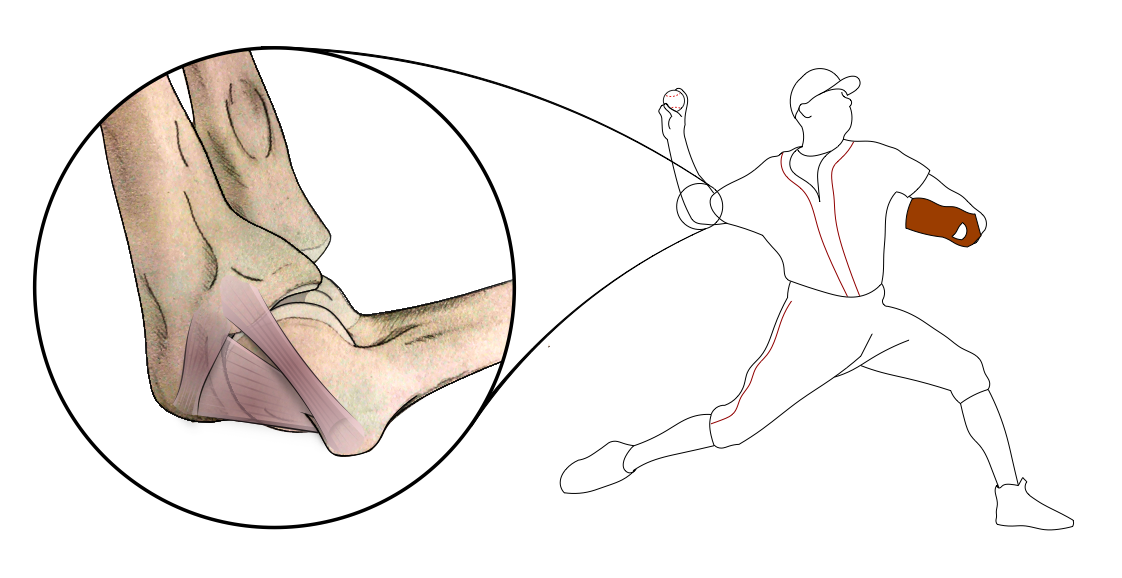
The ulnar collateral ligament (UCL) supports the inner elbow during throwing. Tears can result from sudden injury or repeated loading. Symptoms, stability and activity goals guide treatment.
Examination and imaging assess the ligament. MRI, sometimes an MR arthrogram, identifies tear location; X-rays assess bone. Selected ultrasound studies assess stability under stress.
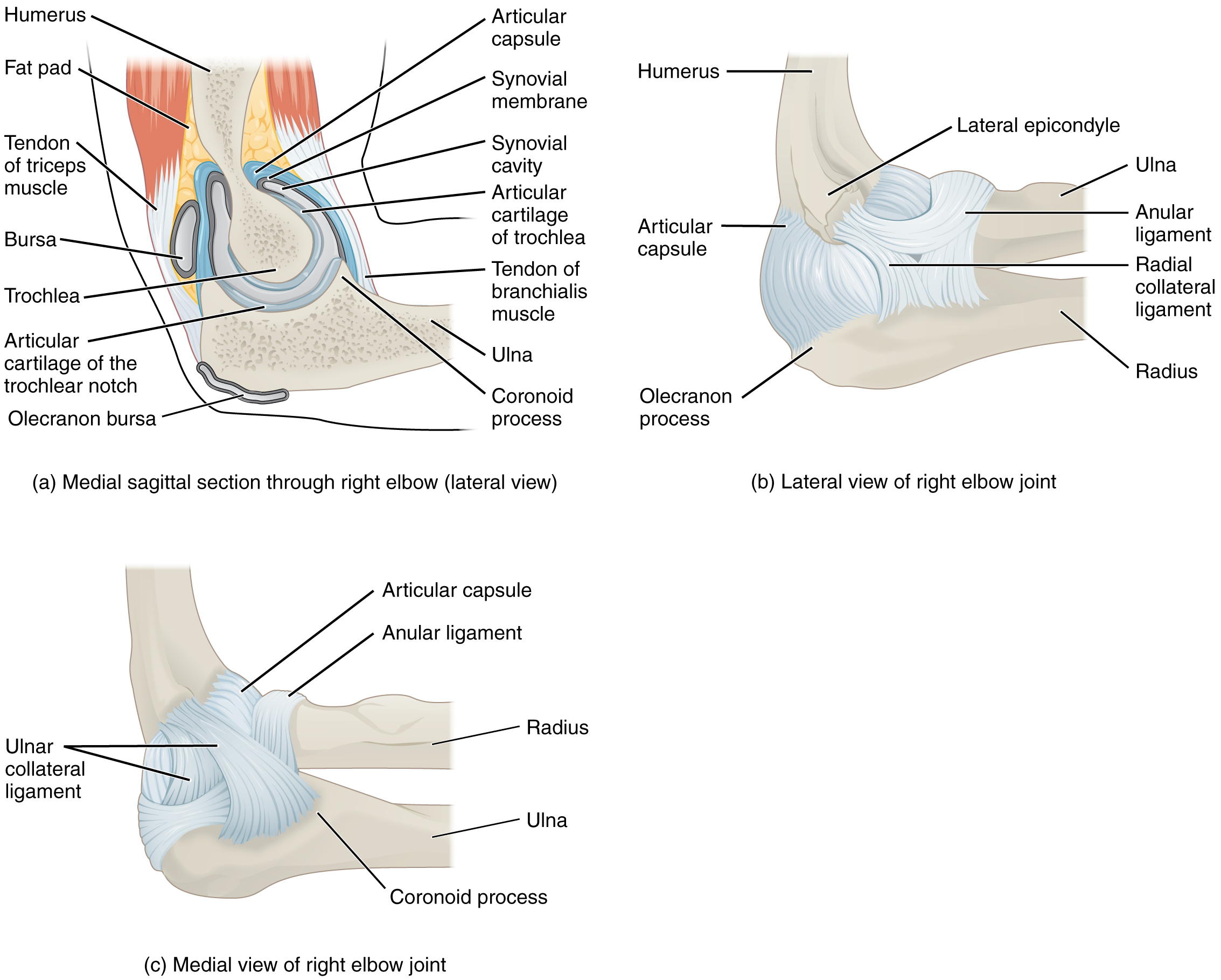
[1]Medial Elbow Anatomy
The UCL During Throwing
When Can It Be Treated without Surgery?
Some partial tears and stable injuries improve with a period away from throwing and an individualized rehabilitation plan. Strength, shoulder motion, trunk and hip function, and throwing mechanics all matter. A gradual throwing progression follows reassessment. PRP may be discussed in selected cases, but its benefit remains uncertain.
[1]A complete tear does not automatically require surgery in someone whose activities do not provoke instability. Persistent pain or instability, inability to return to desired throwing, and the condition of the ligament can make surgery appropriate.
[1]Repair or Reconstruction?
| Factor | UCL repair | UCL reconstruction |
|---|---|---|
| What is done? | Healthy native ligament is reattached to bone, often with reinforcing suture tape. | A tendon graft is used to recreate the ligament’s stabilizing function—often called Tommy John surgery. |
| Tear pattern | Most often a proximal or distal attachment tear, with tissue that can be securely reattached. | Often a midsubstance tear, a chronically stretched ligament or tissue unsuitable for repair. |
| Tissue quality | Preserved, strong tissue is essential. A recent avulsion may be favorable, but timing alone is not decisive. | More appropriate when the native ligament is worn, deficient or cannot hold a durable repair. |
| Activity & age | A carefully selected athlete may be eligible; being young does not guarantee repairability. | An established option for high-demand throwing when repair is unsuitable; prior surgery also affects planning. |
MRI helps plan the operation, but the final tissue assessment may occur during surgery. A plan for repair may therefore include the possibility of reconstruction. A desire for a shorter recovery should not override tissue quality.
[3]What Is an Internal Brace?
An internal brace is strong suture tape fixed to bone with anchors alongside the repaired ligament. It shares load and reinforces the repair as the native tissue heals. It is inside the elbow, unlike a removable external brace.
The tape is not a tendon graft and does not make poor-quality tissue repairable. It can also augment some reconstructions; that remains a graft reconstruction, rather than a repair alone. “InternalBrace” is a trademarked system; the broader concept is suture-tape augmentation.
[4][5]What Grafts Can Be Used for Reconstruction?
| Graft option | Where it comes from | What to consider |
|---|---|---|
| Palmaris longus autograft | Your own forearm tendon. | Commonly used, but some people do not have a suitable palmaris tendon. Harvest avoids donor tissue but creates a second surgical site. |
| Hamstring autograft | Your own gracilis, or sometimes semitendinosus tendon, from the leg. | An alternative when palmaris is absent, inadequate or previously used. Harvest-site symptoms and the amount of tissue needed matter. |
| Tendon allograft | Screened donor tissue, often a hamstring tendon. | Avoids harvesting your own tendon. Processing, incorporation and the available outcomes evidence should be discussed; donor-tissue risks remain. |
Palmaris and hamstring autografts both have established clinical use; evidence has not identified one universal best graft. Allograft is an option in selected patients, including those without suitable autograft tissue. Published allograft series should not be interpreted as proof of equal long-term performance in every type of thrower.
[6][7]What Does the Evidence Show About Recovery?
COMPARATIVE COHORT · 2025
Repair Can Have a Shorter Recovery in Selected Athletes.
A study comparing internal-brace repair with reconstruction found similar patient-reported outcomes and no significant difference in revision rates at midterm follow-up. Athletes selected for repair returned to practice and competition sooner on average.
The groups were not randomized, repair required a suitable attachment tear, and follow-up duration differed. These findings support careful selection; they do not show that repair is superior for every UCL injury or promise a particular return date.
[2]Both operations require rehabilitation and a graduated return to throwing. Readiness depends on healing, motion, strength and sport-specific tolerance. Possible complications include stiffness, ulnar nerve symptoms, persistent pain, reinjury and the need for further surgery.
[1]Questions for Your Visit
- Is my tear at the bone attachment or within the ligament?
- Is the remaining tissue healthy enough to repair?
- If reconstruction is needed, which graft fits my situation?
- Would suture-tape augmentation help, and what are its tradeoffs?
Sources & Further Reading
Evidence checked October 3, 2026. General education; treatment depends on an individual assessment.
- AAOS OrthoInfo — Ulnar collateral ligament injury
- Dugas et al. — Repair with internal brace vs reconstruction in competitive athletes (2025)
- Published technique — Internal bracing for high-grade partial proximal UCL tears (2023)
- Arthrex — InternalBrace system and intended augmentation role
- AAOS surgical education — UCL reconstruction with internal brace augmentation
- Trofa et al. — Palmaris vs hamstring tendon grafts: systematic review (2021)
- Clinical series — Semitendinosus allograft UCL reconstruction (2026)